Related Frameworks
LSCI Within a School-Wide PBIS Framework
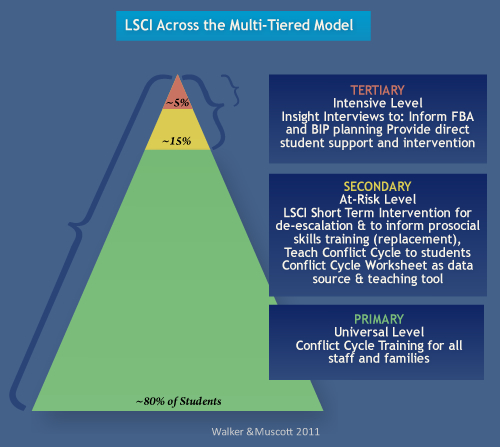
Life Space Crisis intervention is a strategy that is being used in pre-schools, schools, and districts throughout the country as a part of their PBIS/RTI initiatives! LSCI supports school-wide positive behavior interventions and supports (SWPBIS) and Response to Intervention (RTI) behavior initiatives in a number of ways including:
- Provides a systematic, comprehensive approach to addressing escalating behavior that can be used for students in preschool through high school across all three tiers of the PBIS/RTI model (click here to see graphic) as well as in special education settings;
- Systematically integrates evidence-based practices related to crisis prevention and intervention, behavior management, cognitive behavior modification, and prosocial skills training into tiered instruction;
- Provides school staff with proactive, consistent strategies for de-escalating crisis situations that can lead to reductions in suspensions and expulsions, as well as the use of restraint and seclusion;
- Uses incidents of problem behaviors to understand the issues underlying the self-defeating patterns of behavior and re-teaches appropriate replacement behaviors, while promoting the development of positive, supportive relationships with school staff;
- Designed to give school staff and students an increased understanding of the function and other intrapersonal factors related to an ongoing pattern of problem behavior, improving the effectiveness of function-based behavior support plans;
Ask us how LSCI can support your plans for school and program improvement!
Send inquiries to [email protected]
LSCI & Restorative Practices
The fundamental hypothesis of restorative practices is that human beings are happier, more cooperative and productive, and more likely to make positive changes in their behavior when those in positions of authority do things with them, rather than to them or for them (Wachtel & McCold, 2004).
LSCI and restorative practices share the custom of joining with a young person to allow their unique set of perceptions, thoughts, and feelings to be voiced. Both LSCI and restorative practices rely on affective statements and open-ended questions that engage a child’s brain. The LSCI processes extend the restorative questions in addressing proactive and responsive levels within adult-wary youth.
Through both approaches, a young person’s behavior that is often sub-conscious in nature, becomes more conscious, allowing for new insights and long-term change. Dr. Frida Rundell, professor and founding member of the International Institute for Restorative Practices (IIRP), says that “the combination between the two practices is a unique and beneficial win-win for professionals and the adult-wary youth” (2020).
Another way that LSCI and restorative practices align is in their commitment to helping a young person better understand how their behaviors impact others. The Timeline & Insight Stages of the LSCI process focus on cultivating interpersonal understanding. Likewise, LSCI and restorative practices share a focus on restoring and rebuilding relationships where harm or difficulty has been experienced. The idea of repairing relationships and taking responsibility for behavior is the deep learning that takes place in the final two stages of the LSCI process that helps young people learn to build trusting relationships and self-regulate their own behavior.
LSCI in Therapeutic Practice, Residential Treatment Centers (RTC)
& Group Care Settings
Therapeutic Practice
In the classic book, When We Deal With Children (Redl &Wineman, 1966) LSCI is described as “the clinical exploitation of life events.” Authors Fritz Redl & David Wineman go on to describe the purpose of LSCI as, “making use of momentary life experiences in order to draw out of [youth] something that might be of use for long-range therapeutic goals.” Mark Freado, Director of Growing Edge Training and co-author of The Art of Kid Whispering: Reaching the Inside Kid, calls LSCI “a very versatile application that can be adapted to a variety of therapeutic settings and circumstances with young people in need of adults who can be present, attentive, and understanding” (personal communication, July 20, 2020).
Freado explains that LSCI is an excellent process for engaging in a reciprocal dialogue that helps a young person understand and work through problems. Effective LSCI interventions not only address immediate challenges in a youth’s life, but also reveal chronic patterns of self-defeating behaviors. Freado says that it is the recognition of these patterns that sets the stage for positive therapeutic engagement during counseling sessions. Such counseling can take place in the day-to-day functioning of a school, residential, or other program settings, as well as through more formal counseling settings.
Residential Treatment Centers (RTC) & Group Care Settings
James Freeman, Director of Training at Casa Pacifica Centers for Children & Families in California, says that those who work alongside young people in residential or group care settings can see the benefit of both the conceptual and practical elements of LSCI on a daily basis (personal communication, Mar 19, 2020.) He explains that “since most youth are placed in a residential or group care setting to get more help than is available at home, the conceptual elements of LSCI can get the adults (and even peers) aligned with understanding the dynamics of conflict and importance of being heard. The practical elements, most notably the language of insight questions, and social-emotional skills training allows for repeated experience and practice with new ways of thinking and interacting.”
Freeman also notes that the intensity of residential care, in which multiple adults and youth live out their days together provides daily, if not hourly or minute-by-minute opportunity, for adults to learn more about a young person’s perspective or a youth and to be present with them in trying out a new skill in a safe and supported way.
Lastly, Freeman points out that LSCI supports new workers with tangible ‘steps’ of the conflict cycle and a consistent framework for responding to certain behaviors as they focus (rightly so) on the foundation of safety and establishing relationships. At the same time, it allows more experienced workers opportunity to lean more into their relational skills as they trust the skills they’ve gained to navigate conflict and look beyond surface behaviors.
LSCI & Trauma-Informed Practice
One of the most prominent and promising models for helping children whose brains are affected by stress and trauma is Dr. Bruce Perry’s Neurosequential Model of Therapeutics, also known as NMT (Perry & Szalavitz, 2017). As its name indicates, Perry’s model teaches us that the stressed brain has specific needs that must be met in proper sequence in order to be effective. Regulating, Relating & Reasoning are the three essential (and sequential) steps for assessing and addressing the challenging behaviors of young people. We summarize the 3 R’s as follows:
Regulate:
Before we can be of any real help to a person, we must make them feel safe both physically and emotionally. Regulation is a process that involves calming, or in LSCI terms—draining off—the intense emotions triggered in the brain by a stressful event or memory. Adults help kids become more regulated when we do things like providing a space for them to calm down, encouraging deep, rhythmic breathing, giving opportunities for movement to burn off the neurochemicals associated with the fight/flight/freeze response, offering a drink of water, and reassuring them that they are safe. Similarly, co-regulation is a process through which adults purposefully and skillfully use their own calm demeanor as a tool to create feelings of calm in a child.
Regulation and co-regulation skills are standard practice in the LSCI process. Every LSCI intervention begins with providing the time, space, and place for a young person to become physically and emotionally regulated. In LSCI, we call these practices Emotional First Aid & Drain Off.
Relate:
Until a child’s brain is regulated, he/she is unable to relate in any meaningful way with a helping adult. Perry’s model and the LSCI approach share the practice that after regulating/draining off a child’s intense emotions, the next priority is connection and relationship. Adults effectively relate to kids when we listen to them, validate their feelings, decode the meaning behind their behaviors, and affirm that we care about their well-being. In the LSCI model, Regulate & Relate skills are standard practice during what we call Stage 1: Drain Off.
Reason:
Usually when kids are experiencing stress, we observe a high intensity of emotion, along with perhaps loud talking, pacing, crying, defiance, aggressive behavior, self-harm, or other expressions of their feelings. Too often when we see a child seething with emotion after a conflict, we also observe a well-intentioned adult asking them things like, “Why did you do that? What were you thinking? How are you going to fix this? What’s your plan?” We recognize that the adult is trying to be helpful by employing reason with the child. The problem is, of course, that the child can’t process reason, language, and logic at this time because his limbic brain is engaged but his neocortex is not.
Both Dr. Perry and the LSCI approach recognize that real, effective reasoning can only take place after the child is regulated and has established the basis of a trusting relationship with an adult. Once these prerequisites are in place, the child can engage in the higher-level, thinking brain functions of perspective-taking, reflection, and problem-solving.
Stage 2 of the LSCI process, called the Timeline, is a systematic process of helping kids reason by putting language to emotion, telling their stories, and feeling heard and understood. The subsequent LSCI stages extend the reasoning process by fostering insight into troubling patterns of behavior, building pro-social skills, and setting the conditions for long-term behavioral change.
LSCI Within an SEL Framework
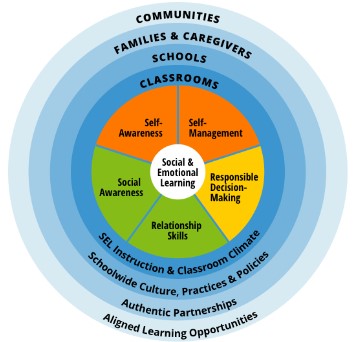
The Collaborative for Social and Emotional Learning (CASEL) defines social emotional learning (SEL) as the process through which all young people and adults acquire and apply the knowledge, skills, and attitudes to develop healthy identities, manage emotions, achieve personal and collective goals, feel and show empathy for others, establish and maintain supportive relationships, and make responsible and caring decisions.
The LSCI approach integrates social emotional learning (SEL) instruction as part of its consistent six-stage process that guides adults in helping young people find solutions for challenging problems. Read on to learn how LSCI supports the CASEL 5–the five core competence areas that articulate what young people need for academic success, school and civic engagement, health and wellness, and fulfilling careers (CASEL, 2022.)
- SELF-AWARENESS: The LSCI Conflict Cycle expands a young person’s ability to understand the connection between their unique set of perceptions, thoughts and feelings and their behavior during stressful situations.
- SOCIAL AWARENESS: Through its Timeline, Insight and New Skills stages, LSCI helps young people increase their awareness of the perspectives of others and builds empathy for peers and adults, including those from diverse backgrounds and cultures.
- RESPONSIBLE DECISION-MAKING: LSCI promotes responsible decision-making by systematically guiding young people to reflect on their behavioral choices and social interactions.
- SELF-MANAGEMENT: Through its trauma-informed lens, LSCI helps young people better understand their perceptions, feelings, and thoughts in ways that allow them to make long-term changes in behavior.
- RELATIONSHIP SKILLS: Based on the belief that young people need to feel heard and understood, along with the knowledge that relationships are the agents of change (Perry & Szalavitz, 2017), the LSCI process cultivates growth, insight, and long-term change into the lives of children, adolescents, and families (Long, et al, 2021).
Reference:
CASEL. (2022). CASEL’S SEL FRAMEWORK: What are the core competence areas and where are they promoted? [White paper]. Retrieved on September 25, 2022. https://casel.org/casel-sel-framework-11-2020/?view=true
LSCI within a Developmental Therapy-Teaching (DTT) Framework
LSCI is a natural partner with the Developmental Therapy-Teaching (DTT) approach to social and emotional learning. Together, LSCI and DTT share a priority for young people under stress and draw from a solid information and evidence base for recommended practices to support the development of each individual — DOING, SAYING, RELATING, and THINKING — with a changing focus for each age and stage of development. From little kids to teens, LSCI and DTT match practices to young people’s developmental needs, recognizing each individual’s journey as a pursuit of identity. Briefly, key LSCI and DTT mutually share these key foundational practices:
- LSCI GOALS lead to responsible behavior through a sequence of emerging stages of social-emotional development.
- The SEQUENTIAL STEPS in LSCI provide a structure for the learning process to stay focused.
- During LSCI, indicators of changes from DEPENDENCE TO INDEPENDENCE provide markers for guiding the developmental process with targeted practices.
- A young person’s view of ADULT AUTHORITY is a major ingredient for LSCI strategies that lead to increased social-emotional gains.
- RECOMMENDED PRACTICES support resolution of naturally occurring developmental anxieties that change with each stage of development.
- VALUES as motivators for social and emotional change are powerful forces for positive change during LSCI.
- ROLES OF ADULTS as agents for change shape children’s responses to crisis events and shape the outcome of each LSCI.
The link to the pdf white paper on Universally Recognized Content in Developmental Therapy-Teaching (DTT) details these foundational practices. Together, LSCI and DTT mutually blend intrinsic resources for dynamic interventions in today’s changing educational technology and learning environments.The sequentially developing stages of social and emotional development are illustrated in The Developmental Therapy Institute website. It also contains information about the key content foundations, resources, teaching practices, and evidence of effectiveness.
www.developmentaltherapyinstitute.org/learn
The Collaborative for Social and Emotional Learning (CASEL) defines social emotional learning (SEL) as the process through which all young people and adults acquire and apply the knowledge, skills, and attitudes to develop healthy identities, manage emotions, achieve personal and collective goals, feel and show empathy for others, establish and maintain supportive relationships, and make responsible and caring decisions.
The LSCI approach integrates social emotional learning (SEL) instruction as part of its consistent six-stage process that guides adults in helping young people find solutions for challenging problems. Read on to learn how LSCI supports the CASEL 5–the five core competence areas that articulate what young people need for academic success, school and civic engagement, health and wellness, and fulfilling careers (CASEL, 2022.)
- SELF-AWARENESS: The LSCI Conflict Cycle expands a young person’s ability to understand the connection between their unique set of perceptions, thoughts and feelings and their behavior during stressful situations.
- SOCIAL AWARENESS: Through its Timeline, Insight and New Skills stages, LSCI helps young people increase their awareness of the perspectives of others and builds empathy for peers and adults, including those from diverse backgrounds and cultures.
- RESPONSIBLE DECISION-MAKING: LSCI promotes responsible decision-making by systematically guiding young people to reflect on their behavioral choices and social interactions.
- SELF-MANAGEMENT: Through its trauma-informed lens, LSCI helps young people better understand their perceptions, feelings, and thoughts in ways that allow them to make long-term changes in behavior.
- RELATIONSHIP SKILLS: Based on the belief that young people need to feel heard and understood, along with the knowledge that relationships are the agents of change (Perry & Szalavitz, 2017), the LSCI process cultivates growth, insight, and long-term change into the lives of children, adolescents, and families (Long, et al, 2021).
Reference:
CASEL. (2022). CASEL’S SEL FRAMEWORK: What are the core competence areas and where are they promoted? [White paper]. Retrieved on September 25, 2022. https://casel.org/casel-sel-framework-11-2020/?view=true